One of the most common questions I hear from families, educators, and professionals supporting a PDAer is:
“How do I provide structure without making it feel like a demand?”
This is one of the most important shifts in understanding PDA.
Traditional models of structure often rely on rigidity, compliance, and clear directives.
For many individuals PDAers, those same approaches can quickly feel overwhelming, controlling, or even threatening. The answer is not to remove structure.
The answer is to redefine what structure looks like.
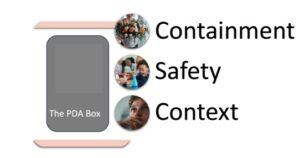
A Visual Representation: The Box
I often describe this using the image of a box. Imagine a box with clear boundaries.
Those boundaries represent:
- safety
- predictability
- consistency
- support
- expectations that are understood
But inside that box, there is room to move freely. The PDAer is not being forced into a rigid path. Instead, they are being given a safe space to navigate within.
The goal is not control. The goal is containment without restriction. This means they know where the edges are, but they are not constantly being pushed against them.
The Safeguards Matter More Than the Walls
The “box” is not meant to be a cage or restrictive. It is a set of safeguards that provides context, safety, and boundaries that help your PDAer operate using the instructions they have been given and apply them with their own creativity and use them in a way that doesn’t activate their biological alarm system.
These safeguards might look like:
- predictable routines
- known transition points
- gentle warnings before changes (changes that they agreed to)
- options instead of commands
- relational check-ins
- co-created plans
- general topics or instructions that allow them to choose their specific activity
These boundaries help reduce the nervous system load that uncertainty often creates. For a PDAer, unpredictability can feel just as threatening as direct demands.
So the boundaries provide safety, not pressure.
Structure Without Rigidity
This is where the distinction becomes so important.
Structure means:
- the environment is understandable, safe, and brings down their hypervigilance
- there are rhythms and routines
- support is reliable and helpful
Rigidity means:
- expectations are inflexible and usually out of reach
- There is little room for autonomy
- deviation feels like failure
- A PDA-informed approach keeps the structure but removes the rigidity.
Instead of:
- “This must happen exactly this way.
We move toward:
- “Here is the framework, and together we can find the path within it.”
Freedom Within Safety
One of the most effective ways to support a PDAer is to provide freedom within safe boundaries.
That might sound like:
- “Would you like to start with this or that?”
- “How would you like to approach this?”
- “What would make this feel easier?”
This keeps the person inside the safe box, while preserving autonomy.
The box is still there. They know the box is there. They know the box will always be there.
What does this mean to them? This means that the consistency is still there, but the movement inside it belongs to them.
Why this works
For individuals with PDA, the nervous system is highly sensitive to perceived loss of control.
When boundaries are experienced as support rather than force, safety increases. When safety increases, capacity follows.
This is where:
- engagement improves
- resistance decreases
- trust grows
- independence becomes possible
Final Thought
Support for PDA is not about removing expectations. It is about creating a safe, flexible framework where the person can move, adapt, and regulate without feeling trapped.
The box is not a limitation.
It is a container for safety.
And within that safety, growth becomes possible.
About Calial McCarty
Therapist, author, advocate, speaker, and founder of McCarty Therapy Solutions, focused on supporting neurodivergent individuals and families through connection-centered, neuro-affirming evidence-based approaches. Calial herself is AuDHD and PDAer. She is a parent to two children who have multiple neurodivergent diagnoses, including PDA.