Do you have a PDA child who struggles in school — or falls apart the moment they walk through the door at home?
Maybe you’ve exhausted your advocating efforts, but your efforts seem to hit a wall. We know contacting your school to ask for more support can feel overwhelming, so we’ve made it easier for you. You don’t have to advocate alone. PDA North America has created FREE tools to help parents ask for support in schools. 

📄 A ready-to-use letter template you can send to your child’s school about PDA & Education training.
🤝 A quick form you can fill out so we can reach out to your school on your behalf.

Together, we can make sure schools better understand and support PDA learners.

Divided into two main parts, along with bonus material on communicating with PDAers, our PDA & Education trainings aim to empower school staff and students. Enroll today and make a difference in the lives of PDA students.

Our PDA & Education Training Includes:

  • Self-paced virtual training from our expert presenters

  • Downloadable PDFs of all presentations

  • Supplemental downloadable materials

  • Unlimited replay access to all sessions for the rest of the school year


By taking the PDA & Education training you’ll walk away able to:

  • Recognize and understand PDA students

  • Design classrooms that meet their unique needs

  • Support students behaviorally and emotionally

  • Develop effective 504 Plans and IEPs for complex learners

  • Apply these approaches to benefit all students — even those without formal diagnoses

Included in the Trainings:

Part 1: 

  • Introduction & Understanding PDA – Clarifying what PDA is (and isn’t) and its link to autism, ADHD and other co-occurring conditions

  • Thinking Differently About Neurodivergence – Updating outdated assumptions about autism to better reflect the lived experiences of neurodivergent students.

  • Supporting PDA Students – Understanding the unique profiles, strengths, and challenges of PDA students.

  • Preventing Student Burnout – Sustainable practices to protect your students well-being.

  • Partnering with Parents – Collaborating to build an effective partnership


Part 2: 

  • Understanding what needs to be accommodated or modified – Building trust, autonomy, and engagement in the classroom.

  • What a 504/IEP looks like for PDA students – What effective accommodations look like in practice.

  • Creating a classroom that meets the needs for PDA students – Steps for creating an environment that meets PDA needs.

  • Supporting PDA Students Behaviorally – Moving beyond traditional behavior management to relational, autonomy-supportive approaches.

  • Crisis Intervention – Strategies to reduce escalation and maintain safety for everyone.


Meet Our Presenters: 

Diane Gould, LCSW, Founder & Executive Director of PDA North America

Zach Morris, M.Ed., PDA Education Consultant


Bonus Training: Communication with PDAers – Interaction styles that invite cooperation.

by Sandra McConnell, “PDA Mama Bear”, Parent Consultant

A Bespoke Option for Individual Schools & Districts

Want a more customized option? We offer an individualized version of this training for schools and districts. It can also be tailored to a specific population.

Why choose this option:

  • Catered to your specific needs

  • Flexibility in schedule including multiple sessions if needed

  • Applicable for all staff or a designated team who can train others within your school or district

  • Optional follow up discussions for parents and paraprofessionals

  • Option to add consultation hours

Contact us for more information: info@pdanorthamerica.org

We’d love to offer an individualized training for your school!

Why This Training Matters

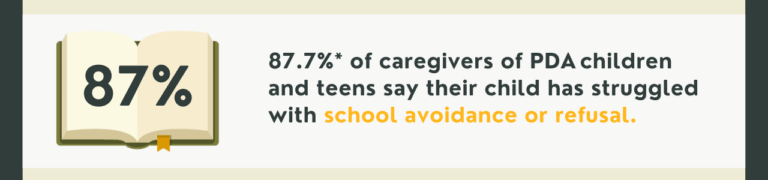
PDA students often experience high levels of school-related anxiety, poor attendance, frequent behavioral challenges, that can lead to disciplinary actions. This is often because their needs are not fully understood. Without the right accommodations, many face academic failure, chronic distress, and 87%* face school avoidance.

This groundbreaking training program will give educators the practical skills to create a safe, accessible, and engaging environment where PDA students can find comfort—while reducing crisis incidents, increasing trust, and improving overall school climate.

*Ref. 87.7% of caregivers of PDA children and teens (under 18) in North America say their child has struggled with school avoidance. The PDA Lived Experience Survey by PDA North America, 2025.